

On 21st July 1989, Milli Vanilli stepped onstage to perform their hit “Girl You Know It’s True” in front of 80,000 fans, for a concert performance going out live on MTV. Moments into the song, the pre‑recorded vocal track jammed and began looping the line “Girl you know it’s…” endlessly, instantly exposing that the duo were not singing live.
It’s not uncommon for artists to mime in TV performances, but the story of Milli Vanilli is one of the most famous in music industry history, as it was eventually revealed that the two men in the band, Rob Pilatus and Fab Morvan, didn’t just lip sync on this performance, but hadn’t sung a single note on their whole album.
Their debut album produced multiple hits and brought the duo international fame and success. They even won the 1990 Grammy for ‘Best New Artist’. But, after the tape malfunction incident, rumours and media scrutiny intensified and in November 1990, it all came crashing down when their music producer Frank Farian admitted that Morvan and Pilatus were not the vocalists on their records and it was actually session singers. The charade had lasted long enough, and the truth came out.
From an outside perspective Milli Vanilli looked like a real band. They were charismatic dancers with striking good looks (much like myself 😉) But unfortunately for them, they couldn’t actually sing for toffee, and attempts to relaunch Milli Vanilli using their actual vocals failed miserably. The perception didn’t match up to reality. This can also happen in financial markets.
Companies may look profitable and growing from the outside, but when they reveal their financials the reality is somewhat different. This situation is even more acute when a company changes from a private to a public business and floats on the stock market via an initial public offering (IPO).
Anthropic, the company behind Claude AI, is expected to list on the public market in mid-November. Anthropic has been in existence less than 5 years yet is expecting to float with a valuation of between $1.4 and $1.75 trillion. To put that in perspective, this would make this relatively new company the same size as Meta, or 4 Coca-Cola’s, or 8 Walt Disney’s, or 13 Starbucks, or… you get the point!
The Big Reveal
In order to float on the stock market a private business needs to file an S-1 document to the Securities Exchange Commission (SEC). This S-1 document compels the company to reveal its financials, risks, business model, governance, and capital structure, and it is the single most important disclosure investors receive before an IPO.
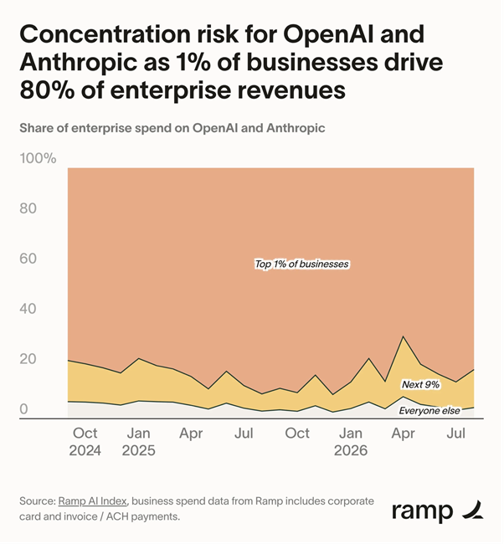
Historically, businesses would float on the stock market after establishing long term track records and well‑understood cost structures. They would be able to show predictable revenue, consistent profitability and a stable customer base. Anthropic’s 300 page S-1 shows none of these things. It shows a snapshot in time of a company that may or may not be profitable in the future. It shows a complex governance structure that gives ordinary shareholders almost no power. It shows that 25 per cent of their revenue was generated from just five customers in the first nine months of the year (In fact, 80% of OpenAI and Anthropic’s enterprise come from 1% of their customers, with the vast majority of those being venture-backed startups). The document also includes 92 pages of “risk factors” including the claim that its technology may pose “catastrophic or existential risks to humanity”, you know, the standard risk stuff!
So, is the business profitable? Well, it was profitable over the second quarter ending in June, but that was largely due to the discounts it received on compute costs. Alas, in quarter three several non-cancellable compute obligations kicked in and the operating profit of $974mn in the second quarter swung to a $567mn loss in the three months to the end of September. Anthropic had previously told their investors that it was profitable on an ‘adjusted basis’ in the third quarter. Well, I am a better tennis player than Roger Federer on an ‘adjusted basis’!
And therein lies the rub. The more these AI companies grow their revenues the higher their costs are becoming. Anthropic’s revenue jumped almost 50% over the last quarter to $17bn, BUT, their spending on chips, power and infrastructure, increased by 77%. With a number of compute spending commitments still yet to commence we still don’t know the amount of money the business will need over the next few years.
IPO. ROI. OMG
Will the Anthropic IPO happen? Probably. The AI industry, and the investment banks who earn healthy fees off this IPO, will move heaven and earth to get it across the line. But the market is getting jittery with the vast capital spending on AI, and there is a chance that we are reaching physical limits to the amounts of capital the broader AI trade can attract.
Is Anthropic worth investing in for the long term? Frankly, I have no idea. But nor does anyone else. When a company has grown so rapidly, and is a little sketchy on the figures, then it is difficult to make a judgment. How do you price extraordinary growth with uncertainty about demand and the inordinate spending required to continue developing the technology?
We have previously written about our concerns over the AI bubble, and in particular the level of financial circularity within the tech sector, the vast sums being committed and the concentration risk in markets. The details surrounding the proposed IPOs for Anthropic and OpenAI do nothing to assuage these concerns.
When it comes to AI-related companies, the amount of money being spent on capex can only be justified by a complete technological and productivity revolution, and there is minimal margin for error. Eventually all the spending has to translate into a return on investment (ROI) and if the funding starts to dry up there will be a lot of companies scrambling for cash to stay in business.
When the music stops we will find out who can actually sing and who is miming.
Sad but true
After the Milli Vanilli scandal broke, the backlash was immediate. The band had their Grammy award revoked (the first time this had ever happened), their albums were recalled from shops, and they faced public ridicule.
The duo attempted a comeback using their real voices, but the stigma was impossible to overcome. Fab Morvan eventually rebuilt a modest career, but sadly, Rob Pilatus spiralled into addiction and died in 1998.
The band took the brunt of the backlash, but the music producers and record label, you know, the people who actually made money from the band, emerged unscathed. They didn’t have faith in the long term future of the band and ended their contract. They made their money and ran.
When Anthropic floats their founders and early investors will own shares worth a lot of money. But it will be worth watching to see whether they keep their shares for the long term, or whether they dump these shares on the public at the first available opportunity? Will they make their money and run?
Girl, you know what’s true.
Sources: FT.com, Bloomberg, Ed Zitron, WIkipedia


