

As you embark on your summer holiday, I wanted to set you a challenge. Get some friends in the pool with a volleyball and see if you can beat 280 at Tappy-Tappy. This, as far as I am concerned, is a ‘world’ record, and was achieved by four of us in a swimming pool in Greece two years ago. I have contacted Guinness but they don’t seem very interested. We call it Tappy-Tappy. You may know the game as another name, but you will have undoubtably played it. The rules are very straightforward – Keep the volleyball in the air without it hitting the water. To achieve a score of 280 you can’t have any weak links (you know who you are) and it requires miraculous feats of agility to keep the ball from hitting water in the event of wayward ‘Tap’. Go ahead, try to beat 280. But I will require proof!
Anyway, if you took the same ball and held it under the water it will of course rise back to the surface. Without intervention the ball will always revert to its natural level. And the same is true for financial markets. You can intervene in currency, bond, equity and commodity markets but when all is said and done the market will find its level based on fundamentals and sentiment.
Central banks intervening in markets is nothing new, but the majority of the time it is undertaken behind closed doors or perhaps though third parties such as investment banks. This is why the very public intervention from both US and Japan to prop up the Japanese Yen last week, their first joint intervention in 15 years, is noteworthy.
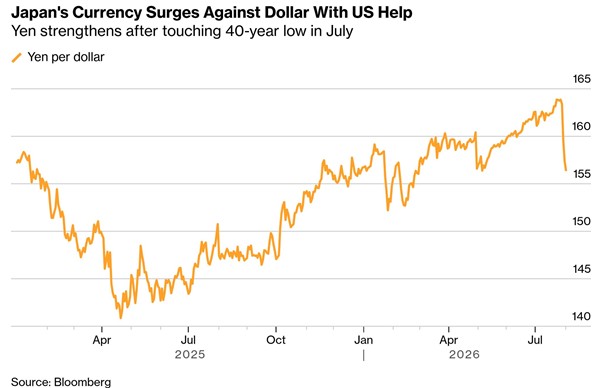
The Japanese yen (JPY) has been under pressure in the last few years due to the wide interest rate gap with the US and other major economies which has encouraged investors to borrow cheaply in yen and invest overseas, often referred to as the ‘yen carry trade’. In addition, the yen has weakened due to worries that the Japanese government is spending beyond its means and is also under pressure recently from rising oil prices, given that Japan imports almost all of its energy, and needs to sell JPY for US dollars to pay for it. This is causing a lot of pain for businesses and consumers in Japan, who for decades have not experienced persistent inflation.
Big Trouble in Little Tokyo
If you are thinking to yourself ‘that seems very generous of the US – selflessly helping one of its allies’ then prepare to be disappointed. A weak Japanese yen is a threat to the US financial system.
The US has two main problems; one right now and one in the medium term. Japan is the largest foreign holder of US Treasuries, and the when the Bank of Japan sells US treasuries to defend it’s currency this pushes down US bond prices and increasing borrowing costs (the yield) which is already high. The yield on a 30-year bond is currently 5.23%, which is the highest level since June 2007. This has a knock on effect for mortgage rates which are creeping up to 7% at time when energy prices are also biting, and the average US consumer is struggling. In November there are mid-term elections in the US and Donny T will not want the Fed to raise interest rates, regardless of inflation.
Secondly, the demand from investors wanting to own US treasuries is drying up quicker than my garden lawn. China has been reducing their US dollar denominated reserves for a number of years, and Middle East investors need their spare dollars to replace lost oil revenue. In addition, the vast debt issuance from the big tech hyperscalers (you didn’t think that we could write an article without mentioning AI, did you?) creates real competition for capital that the US treasury has never faced before. Lastly, and perhaps the more serious problem, is the yen carry trade starts to reverse and the trillions of dollars in capital invested is repatriated to Japan, things could start to become very messy. As the yen depreciates, the cost of borrowing JPY increases, and it becomes less attractive to borrow in JPY and invest in assets outside Japan. Stickier inflation should eventually push the Bank of Japan to raise interest rates, which is not palatable for either Japan or the US.
Trust me, I am a hedge fund manager
So this is the ‘why’ the US has intervened, which brings us to the next question – ‘why announce it publicly’. Over the last few months there have been multiple occasions where the oil price has been stopped from going higher by huge sell trades in the futures market. The source of trades is not known but Scott Bessant, the ex-hedge fund manager turned politician who has demonstrated a strong willingness to intervene in markets, denies any involvement from the US, so we can obviously trust him. This reason the recent JPY intervention was publicly announced is Scott Bessent is sending a clear signal to currency traders… the US will do whatever it can to prop up the Japanese yen (which will prevent US bond yields from soaring).
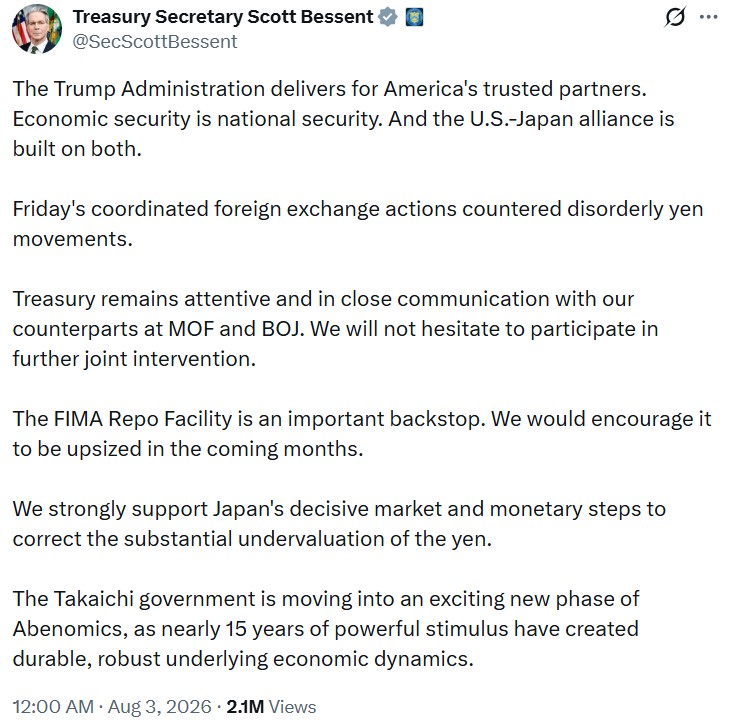
Ironically, Bessent made his name as a lead member of the Soros Fund Management team whose bet against pound sterling caused the Black Wednesday collapse in 1992, so he has seen first hand the futility of currency intervention when the market is against you.
Ultimately, this currency intervention just buys a little time. If successful, the Bank of Japan may hold off on a rate hike in September, but without structural changes the currency will remain under pressure and so will US treasury bonds. The US is a big beast and has enormous fire power to take on the market, but with total debt burden of nearly $40 trillion, and the government borrowing an average of $7 billion dollars every single day, they are running out of road..
Back in October 2024 we wrote in our article Taking it to the brink “Just like the engineers at Chernobyl, the US government has created an unstable system, and if inflation starts to creep back up at the same time the economy starts to slow, then the situation could get out of control”.
It is no surprise to us that every time the oil prices start to rise there is a fresh announcement about a peace deal in Iran, the threat of higher inflation will push up borrowing costs. The system is creaking and all the various attempts to intervene and manipulate in markets increasingly look like acts of desperation. The central bank will ultimately be forced to intervene, printing new currency to absorb the debt that the private market refuses to buy. Holding gold as a store of value in our portfolios makes more sense than ever.
Just like the Tappy-Tappy ball, you can only hold it under the water for so long, eventually it will rise to the surface.
Enjoy your holidays, and if you don’t beat 280 then don’t feel bad. Take comfort in the fact that we were an elite crew of highly trained athletes, who almost definitely hadn’t been on the rum cocktails…


