

I can’t seem to get excited about the World Cup. Perhaps it’s the time difference, with many games played overnight, or the sheer number of teams (where even is Curacao??). Perhaps I have PTSD from last season seeing West Ham get relegated. Or perhaps its an age thing. World Cups used to seem genuinely exciting. It was an opportunity to watch fantastic players you wouldn’t regularly get to see on TV, like Maradona, Zico or Platini. It was the chance to see players with crazy names and equally exotic haircuts, like Carlos Valderrama, Ruud Guillet or Chris Waddle!
Before I go into full-tilt old man mode, there is one aspect of football in the pre-internet age that was amazing… the Panini sticker album. For any youngsters who read these articles- this is not some sort of Italian sandwich, but a blank scrapbook where you aim to collect stickers for every player in every team. The goal is simple but addictive: complete the entire album. Packs of stickers were purchased from local newsagents, and any duplicates could be traded with school friends who were also collecting. It was a playground ritual. The trading rules were fairly simple. One-for-one on player stickers, but the metallic team badge, aka the ‘shinies’, were worth at least two standard player stickers. However, it wasn’t uncommon to trade huge stacks of stickers just to secure that one elusive player or team badge required to complete the page. At my school, the Argentina badge for the 1986 album was THE swapsie to have. Owners of this particular sticker would strut round the playground like an 11-year-old Simon Le Bon!
The football sticker secondary market works like any market – prices are established by supply and demand, prices go up when demand outstrips supply, and falls when there is more supply than demand.
If you have children of a certain age you may may remember the short-lived craze of the Prime energy drink a few years back. The drink had been launched and promoted by influencers who stimulated the demand on social media, but then limited the supply to shops. Teenagers went nuts! It was similar to the scramble for toilet rolls in Covid, but without rationality.
Demand isn’t always logical, or based on fundamental reasons, but it can temporarily prevail. But eventually, the rule of supply and demand always wins out.
The recent SpaceX IPO (you may have heard about it) and the anticipated IPO’s of Anthropic and OpenAI are about to test the limits of investor demand. These are not small fledgling businesses coming to the market for capital, they are being valued as some of the biggest businesses in the world and will create a massive pay day for their founders and early investors. Without getting into the specifics of these particular loss-making businesses, the key question is how will equity investors respond. Will they increase their overall allocation to equities? Or will they sell exiting equities to make room for the new boys? Or will they not buy at all? Ok, that last option was just for giggles. There is always demand for US equities, right? Well, yes, of course. But what about supply?
Getting High on Limited Supply
The impressive returns in the US stock market over the last 20 years have occurred at a time where the supply of shares has been reducing, primarily through companies buying back their own shares. But the US market is now close to ending more than two decades of declining equity supply.
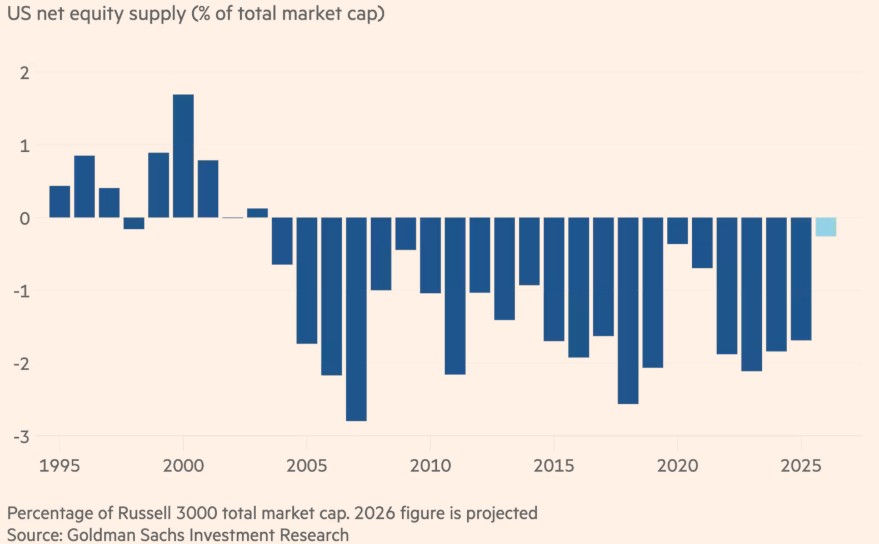
As reported in the FT, Goldman Sachs estimates net supply of equity in the US (measured by new shares hitting the market less equity removed by buybacks or companies going private) will be almost flat in 2026, having been in negative territory since 2003, and there will be an even greater influx of new shares in 2027, as lock-up periods on this year’s IPOs expire.
This change in the supply dynamic is occurring at the very same time many companies are moving away from a capex-light business model, where they used their surplus cash to buy back shares, towards a capital-intensive model, where they are using all their cash to build out AI infrastructure.
Alphabet raised nearly $85bn last month by issuing shares to fund its vast AI strategy, which marks a major shift in how they use their cash flow, and means that the Google owner will be a net issuer of stock for the first time in 11 years. With most of the big tech companies now heavily involved in the AI arms race and trying to outspend each other, it would not be surprising for other hyperscalers to also raise money by issuing shares.
So how much of the broad stock rally over the past decade has been about the reducing supply of shares, and how much is about the insatiable demand for US equities from investors? We are about to find out…
Italian Job
Companies who have a product, service or asset that is not easily replaced can create substantial value for their shareholders in the long term.
Brothers Benito and Giuseppe Panini founded the Panini Group in 1961 in Modena, Italy. After securing the rights to the 1970 World Cup the company became synonymous with football sticker albums in the 70’s and 80’s and is now the international brand leader in the world of stickers. Just down the road from the Panini group is another company from Modena that understands the power of supply. Ferrari are renowned for manufacturing a limited number of cars each year, to ensure their cars are not widely available and therefore maintain their prestige status by limiting supply. However, the recent launch of their first electric vehicle was widely criticised, so we wait and see whether demand continues to follow.
Eventually, the law of supply and demand will always decide market prices. Even in the world of football stickers this dynamic holds true. The highest price ever paid for a single Panini sticker at auction was for a pristine 1979-80 Diego Maradona rookie sticker. This rare collectible marks Maradona’s very first appearance in a major sticker album. This sticker fetched $555,960. Not a bad return on a pack of stickers that cost just 5p. Or 75 Italian Lira.


