

Up until the 1970’s, FIFA was a small, conservative and largely European organisation. When the Brazilian João Havelange was elected as president of football’s governing body in 1974 that all changed. Havelange, alongside his young general secretary Sepp Blatter (remember him), paved the way for the huge commercial expansion of the World Cup tournament, and oversaw an explosion in the governing body’s revenues as broadcasting and sponsorship deals rolled in. And as the deals rolled in, many of FIFA’s executives’ pockets were handsomely lined. Havelange structured FIFA like an organised crime racket. All the media rights were controlled by the organisation, and the executive committee decides which country gets to host the World Cup and who gets the money. The man at the top (the president) is kept there by the representatives of each country’s football association voting for him, and these representatives are rewarded with World Cup tickets and money for their own country. And as every country wants to host the World Cup they don’t want to rock the boat by claiming ‘corruption’. This circular system, which has no ultimate regulatory oversight, created the perfect environment for bad actors to profit. As Charlie Munger once said- “show me the incentive, and I will show you the outcome”.
In the 80’s and 90’s many Japanese companies bought shares in their customers and suppliers to ‘build long term stable business relationships’ and to defend themselves against corporate raiders (think Gordon Gekko). This practice of cross-shareholding, known as keiretsu, worked well when the market was going up, but when the bubble burst in 1990 this exposed how interconnected and reliant these firms were on each other. Japanese firms have taken decades to unwind these cross-shareholders and is one of the factors that hampered the market’s recovery for so long.
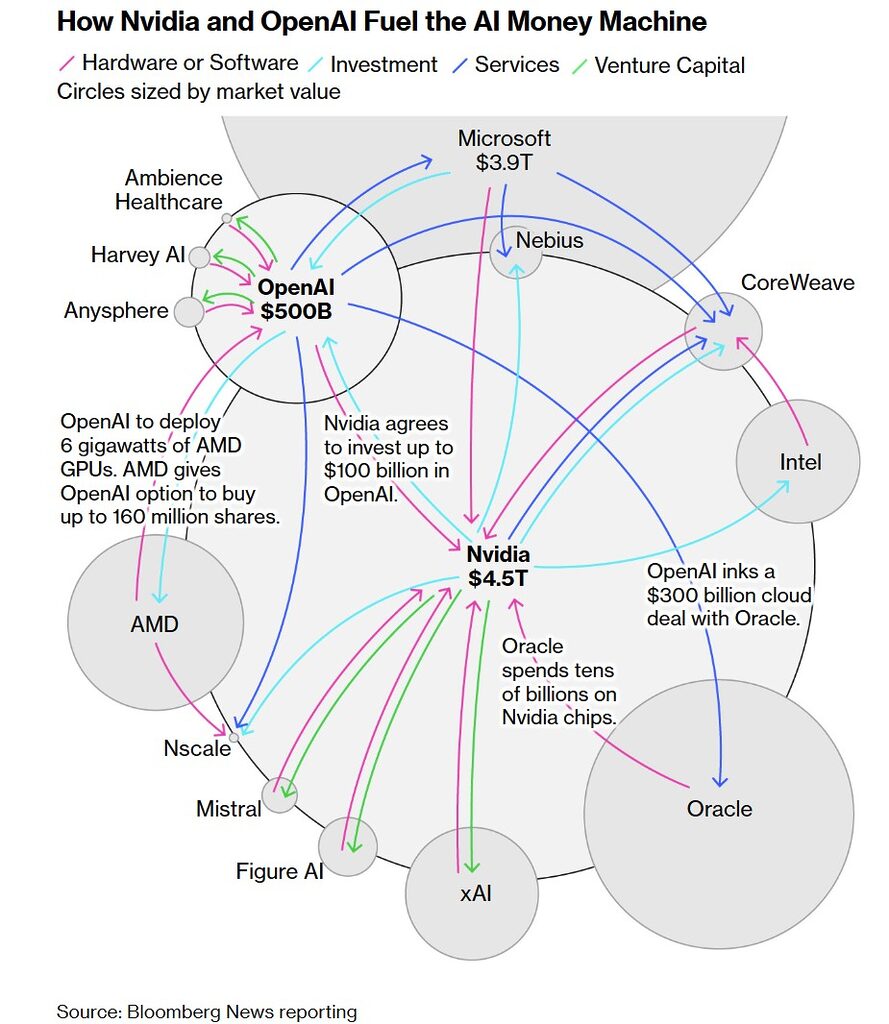
So why is this important in today’s market? Well, the inordinate sums of money and blanket media attention that AI attracts has left many people, ourselves included, convinced we are in an AI bubble. AI is here to stay and will undoubtably have an impact on all of our lives, but for all its potential it remains largely unproven as a sustainable profit-making activity for many of the parties involved. This hasn’t stopped most of the tech companies competing to outspend each other in pursuit of winning the ‘AI arms race’, and at the centre of this frenzy are Nvidia (chip maker) and OpenAI (ChatGPT creator). The below chart from Bloomberg last month shows how an increasingly complex and interconnected web of business transactions is artificially propping up the trillion-dollar AI boom.
Unlike the smartphone boom, which piggybacked on broadband infrastructure built during the dotcom bubble, the requirement for capital expenditure for AI is vast. According to Morgan Stanley Research, the estimated spending on AI infrastructure, such as hardware and data centres, over the next three years will be $2.9 trillion dollars. This doesn’t even include the electricity costs required. About half of this will be funded with cash from the big tech ‘hyperscalers’, and the other half will be debt, assuming there are enough people willing to finance the build out.
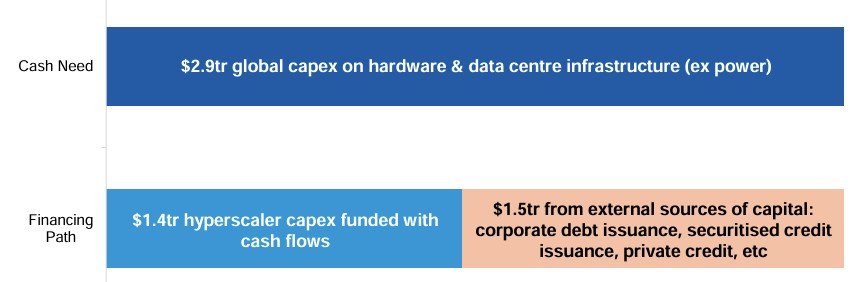
Source: Morgan Stanley Research, Estimated Capex 2025-2028
This is the paradox of these AI companies – they are exciting but dangerous. Take OpenAI, a pioneer of AI and their ChatGPT product has probably been used by the majority of people. OpenAI is a still a private company and there is a lot of buzz about them floating on the stock market next year, with many claiming the company could be the first ever $1 trillion IPO. That all sounds great until you realise that even though ChatGPT has 800m weekly users, only 20 million pay for the service. OpenAI has never made a profit, it currently has $1.4 trillion in spending commitments over the next eight years, but the company only makes about $20bn a year. Where is the money going to come from? Last week OpenAI’s CFO suggested the US government should support this spending if OpenAI got into trouble, as ultimately it was for the good of the US economy. This is the equivalent of my son racking up debts on my credit card then telling me I need to pay it if he can’t afford the repayments because it will affect my credit rating! OpenAI has since backtracked on these comments, but it highlights that eventually lofty spending commitments hit reality.
For most investors, the only question that matters is how much longer the bubble can last. Unfortunately, there is no easy way to answer this question and no simple metrics that can help investors navigate these markets, but if we may offer a few observations:
- The ‘winner takes all’ nature of AI spending has exaggerated the spending requirements far beyond what is needed
- The current circularity of deals between companies is very concerning
- As we saw with DeepSeek in January, there will be cheaper options that can challenge the current assumptions
- The ability to produce cheap electricity will become a key factor in the AI arms race
- Other sectors will also benefit, such as EVs, robotics and biotech
Within our portfolios we have minimal exposure to pure AI related companies and prefer to find investment themes that are underhyped and undervalued.
When all parties are interconnected there is an incentive for everyone to keep the train on the tracks. The FIFA executive thought it was untouchable, and after years of corruption allegations the FBI finally got involved and raided FIFA’s offices in 2015. Over two dozen executives were indicted and many of the ‘under the table’ deals finally came to light.
Circularity benefits everyone in the good times but when the money dries up the zombies begin to appear.


