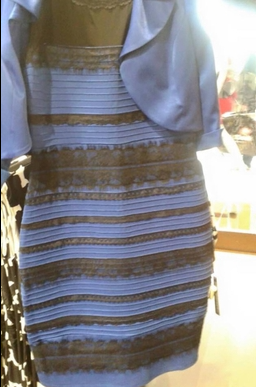
Did you see white & gold, or blue & black?
For those of you who can’t remember 10 days ago, let alone 10 years ago, this was the viral debate of 2015. It all started when a lady in Scotland posted a photograph of a dress on Facebook. The dress was black and blue, but the conditions of the photograph caused many to perceive it as white and gold, creating a huge online debate. Within a week, more than ten million tweets had mentioned the dress (Thankfully, the internet is a much more sensible, thoughtful and less divisive place these days 😬 <cue tumbleweed>) There is a very scientific explanation as to why people see one colour or the other… but I am not going to try to explain chromatic adaption, besides, you didn’t come here for that content.
We have previously written about how concentrated, and expensive, the US market has become. The top 10 US stocks are now cumulatively valued at about $25 trillion, which is 6.5x bigger than the entire UK stock market. These top 10 companies now account for 39% of the whole US market and the tech sector alone is 34% of the US market. These figures are wild, but incredibly, the official tech sector doesn’t include tech-focused companies like Amazon, Tesla, Alphabet, Meta, and Netflix. When you include these companies the total tech-related exposure rises to 48.7% of the S&P 500. However you want to cut it, when you invest in the US market half of your money is going into the tech sector.
This is one way to look at the situation. The other way is to observe how ‘defensive’ sectors now represent their smallest ever proportion of the US market. Companies in the consumer staples (e.g Wallmart, Target, Coca-Cola etc), energy, healthcare and utilities sectors now only represent 20.8% of the market. This figure is now lower than it was at the time of the dotcom bubble bursting. It takes a braver man than me to predict when this current bubble will burst, but there are worrying signs.
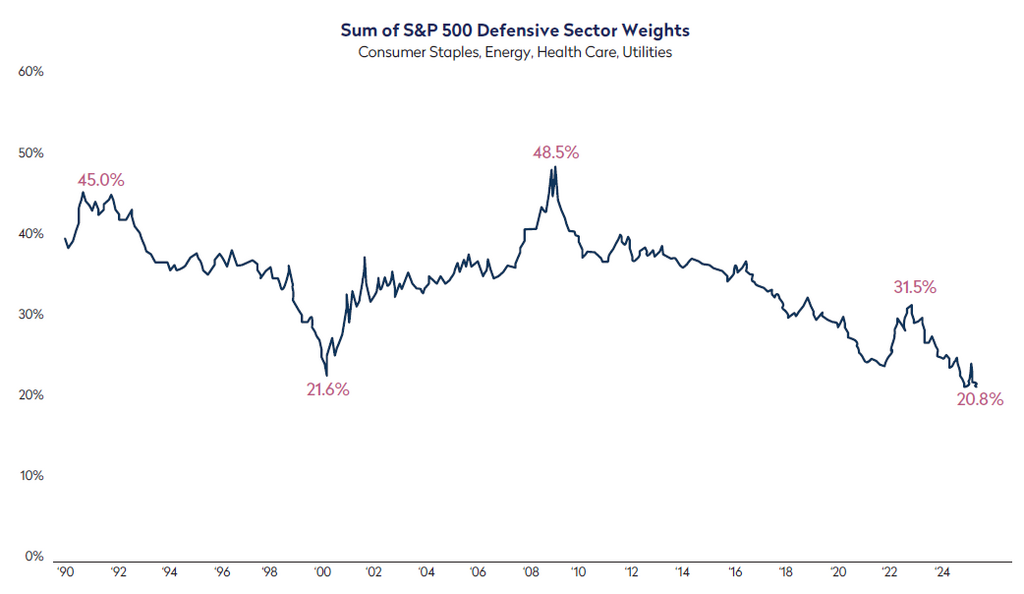
They say it takes two to make a market. Clearly many, many people still believe that investing in tech companies is the only game in town, and the sector will continue to dominate. Perhaps many investors are also experiencing FOMO, and don’t rule out good old fashioned career risk whereby you have to invest in the same stuff as everyone else or risk underperforming the average. This works until it doesn’t. There are now sectors that are now at extreme levels of under valuation, and I would wager that if the global economy stalls, or the tech bubble bursts (or both) that owning companies in defensive sectors that produce necessary goods will be a sensible move.
Perhaps this is one of those times where being older actually helps. Of the approximately 1,700 active large-cap US portfolio managers, just 4% invested through the dotcom period. Most money managers today do not carry the scars of the era.
Markets are a matter of perception. We need to ask ourselves “what have we missed”. If everyone is seeing blue and black, should we be seeing white and gold? We need to be ready to zig when others are zagging.
Without opening up old wounds…What do you see?