

How are you reading this article? On a laptop? On an iPad? If you are like my old luddite colleague, you may have even printed it off to read in your armchair later. But I would wager that a good proportion of you are reading this article on your phone on the train.
My train journey home used to involve doing the crossword in the Evening Standard, but as this is no longer a daily publication I have fallen into a new routine – watching old school action films on my phone. It’s actually a great way to decompress. I have recently watched The Rock, Bad Boys, Speed and Enemy of The State, and up next… Point Break. What a time to be alive. Streaming a film straight from Hollywood to a small device that sits in your pocket. When you think about it, the technology is quite remarkable, but what is even more remarkable is how the iPhone is actually made.
Apple’s iPhone has 2,700 individual parts and is triumph of design, software and marketing. But the supply chain Apple has built over the last 20 years is arguably even more impressive. This supply chain is hugely sophisticated and requires specialist knowledge, equipment and materials, using 187 suppliers across 28 countries to assemble the phone.
Equally, the process involved to manufacture silicone chips, like the one in your phone, could be from a science fiction novel, using high powered lasers and chemicals to create smaller and smaller chips that push the boundaries of their atomic limits. The latest Nvidia GPU chip squeezes about 208 billion transistors onto a board the size of an iPad. As Ed Conway points out in his excellent book Material World “Few, even in the (semiconductor) industry itself, understand the length and complexity of this journey, the number of processes involved, the quantity of companies playing a part… When politicians talk lazily about re-shoring, it often betrays a deep ignorance of what is happening out there in the Material World.”
Seamless free trade and efficient supply chains were the hallmarks of globalisation, but the world is increasing becoming de-globalised. Trade barriers and military conflicts are occurring at the same time trillions of dollars is being spent on the build out for AI. The real bottleneck for AI is not it’s algorithmic capability or the ability to produce fun videos; it is the physical infrastructure required to power it. AI needs data centres. Data centres need copper, steel, cement, electricity, cooling systems, transformers, land (and permission to build!), and a LOT of water. Building enough data centre compute capacity is really difficult, far more difficult than most tech companies would like to admit and many have succumbed to the curse the HS2 trainline… forever under construction.
Let’s get physical
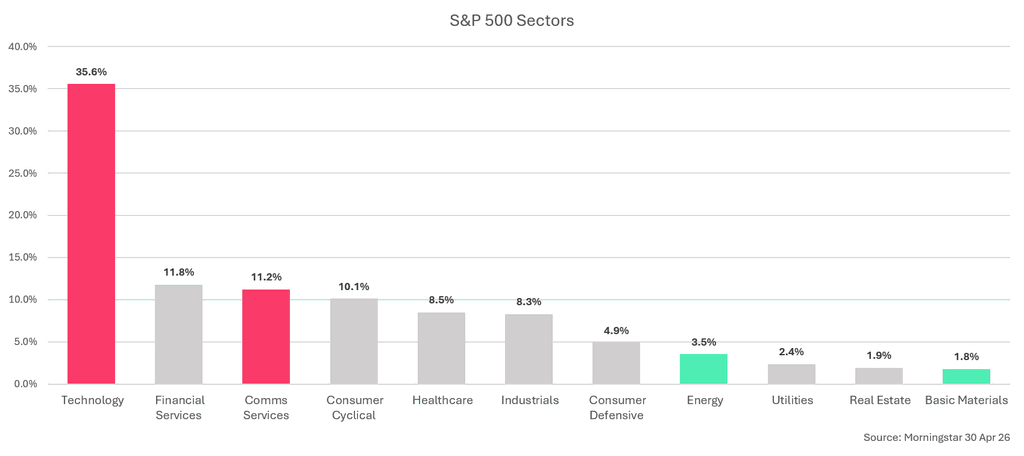
For the last decade, investors have thrown money at all things digital. Software. Platforms. Apps. Digital networks, while the physical assets required to run the tech has largely been starved of capital. Today, the Information Technology and Communications Services sectors are roughly 47% of the S&P 500, while Energy and Materials make up less than 6% of the market.
This seems an unsteady balance. The physical, boring things the world needs, but cannot make enough of, have been ignored and supply chains are staring to rattle.
The S&P500 is a $60 trillion market, so even a small rotation from the digital to the physical over the next few years would be a significant tailwind. The ‘boring’ stuff is about to become exciting.
Electric Dreams
Anyone who follows our updates won’t be surprised to learn that we are positioning our portfolios for this potential rotation, and see far greater upside in commodities and energy.
The ongoing middle eastern conflict has brought supply chain vulnerabilities into sharp focus and commodity markets are entering an era where critical raw minerals have become strategic assets. Governments are increasingly intervening in markets to shore up the supply chains for the critical materials needed for their defence requirements, technological ambitions, and food security.
Likewise, the closure of the Strait of Hormuz has created shortages of energy, and inventories are rapidly being run down. Higher energy prices will inevitably speed up the existing trend towards clean energy generation and electrification.
After two decades of near-flat growth, electricity demand is growing fast, driven by the demand for AI data centres, manufacturing, and electric vehicles. Meeting expanding power needs will likely require a significant buildout of both power generation facilities and power grid infrastructure and we have recently added a small position to the portfolios which will benefit from this spend. This fund invests in companies who provide technological solutions to the global electrification and decarbonisation supercycle.
Chain of ferrules
The modern economy is hugely complex, but sophisticated global supply chains are nothing new. In 1958 Leonard Read wrote an essay called I, Pencil which illustrates how free markets coordinate complex global supply chains. The essay became popularised by free market economists as the story explains that not a single person on earth knows how to make a pencil entirely from scratch. The text traces the massive global cooperation needed to harvest the Oregon cedar, mine the Sri Lankan graphite, mix the Indonesian rubber ingredients, forge the brass ferrule, and transport the materials. Read’s core message is that millions of people collaborate without knowing or caring about each other’s existence and are guided by the invisible hand of the market.
Many years after I, Pencil was published, a London design student decided he would try to build a toaster from scratch. The story is told here on Tim Harford’s blog. As you can imagine, it was trickier than you think and once again confirms that even the simplest of products is reliant on global supply chains, but thankfully it means we don’t have to pay £500 for a machine to toast our bagels!
The moral of story is simple. Don’t underestimate the complexity of supply chains and the boring stuff that is needed to build things and then make them run. The potential impact of AI in our lives is both extraordinary and massively overhyped in equal measures. For all its potential it remains largely unproven as a sustainable profit-making activity for many of the parties involved. The digital world tells us anything is possible, but the physical world still has boundaries, and eventually the market will recognise this.
I’m off home now. So, should I read some economic research on the train, or fire up the next action flick on my phone? I think you know the answer…


