

With gold and silver prices on a tear I bet you thought today’s update would be about precious metals. Well, sorry to disappoint, but multiply that disappointment by about a billion, and that is how it feels to be a West Ham fan. After just 6 games this season, we may already need a new manager.
So, on the subject of continually changing leaders, France is on the lookout for a new Prime Minister. This will be their fifth leader in less than two years, a miserable reflection of the country’s fractured political landscape. Last week, France’s debt was also downgraded by a second rating agency in the space of a week, underscoring doubts that the country can deliver on promises to reduce their debt. France’s debt to GDP ratio is projected to rise to 125% by 2030 if politicians can’t agree on measures to bring them under control.
The first stage of addressing any addiction is to admit the problem. We have seen this in the UK. After years of underinvestment in public services, compounded by foreign investment drying up after the Brexit vote, and the healthcare and pension costs of an aging population growing at an ever-increasing rate, UK finances currently look bleak. It takes a brave politician to risk upsetting the over 65’s, and of course is far easier to just blame immigrants, but as we have seen the search for easy answers leads to political paralysis, and political paralysis eventually leads to economic damage.
The French president Emmanuel Macron has at least recognised the situation, saying the “years of abundance are over” and rightly pointing out that higher pension payments are a drag on the state’s finances. To which everyone agreed, accepted the sensible proposals and toasted the president with nice glass of Chablis. Only joking. Funnily enough, it didn’t go down too well, and predictably Macron’s proposal to push through a rise in the retirement age from 62 was met with protests across France. Every subsequent proposal to address the situation since has taken down the prime minister in the process.
French pensioners are far from hard done by. Not only do they receive larger payments from the government than their counterparts anywhere else in the west, but they also start receiving them several years earlier. The result is a situation in which over-65s now have higher average incomes than the working age population, which according to the FT is “unique both internationally and in France’s own history”
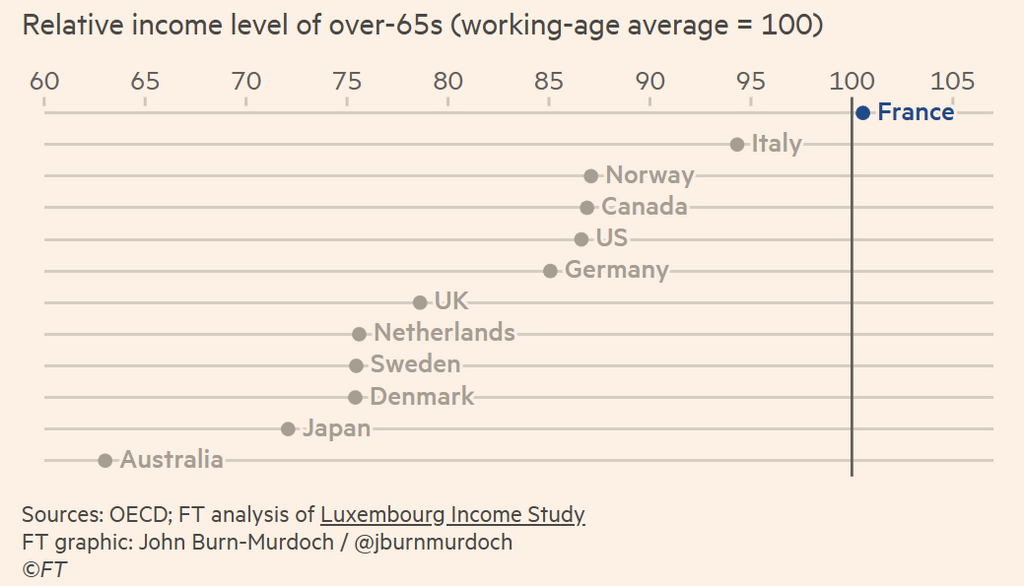
This is a wild situation. It cannot be sustainable to have a society where workers (who typically have higher outgoings) earn less than retired people (who have typically lower outgoings). The UK is not in this position yet, but the ‘triple lock’ on pension ensures elderly living standards increase at a faster rate than everyone else’s. It is no great surprise that birth rates are falling rapidly in much of the OECD.
From an economic point of view, investors are not going to lend governments money if they don’t have the confidence they have their budgets under control. Last week we saw this in the US. Even after interest rates were cut, 10-year government bonds sold-off and the yield went up. The bond market is sending a clear and unambiguous message – lending you money for 10 years is a risky business, and we require a higher rate of interest. It is a matter of confidence. Similarly, UK Government bonds are backup in to ‘Truss territory’ and early this month a number of blue-chip French companies’ bonds had lower yields than French government debt. This is a perverse situation when investors feel that corporations are a safer bet then the sovereign nation, it is the sort of thing you would typically associate with emerging market economies, not a G7 country.
At the moment it seems to be just a political crisis in France, but in the future it could become a debt crisis or an economic crisis. The burden of debt is now weighing on a number of economies, and is one of the reasons why we diversify our bond exposure into alternatives such as gold and commodities, and why we prefer shorter dated bonds for our fixed income exposure. Don’t just take our word for it, the Morgan Stanley CIO has recently suggested investors shift from the traditional 60/40 equity/bond portfolio into a 60/20/20 strategy of equity/bonds/gold.
By the time you read this France may have a new prime minister, West Ham might have a new manager, or Trump might have, well, Trump might have done conceivably any crazy thing. We live in a world where it pays to be flexible in your investment process, to think differently and not conform to conventional asset allocations. It’s time to be investment rebels.
On y va!


