

My friend once bought me an elephant for my living room, I said “thanks” and he said “don’t mention it”.
Ok, bit of a dad joke, but some of you are laughing. Joking aside, what is the opposite of the phrase ‘the elephant in the room’? I am not sure there is one. The phrase for the big thing that EVERYONE is talking about. The elephant in the room you can’t avoid hearing about. The ubiquitous elephant.
Currently that elephant is Donald Trump, or perhaps Elon Musk. Its only been about a month since the inauguration and I am already exhausted. There have already been announcements about bringing back plastic straws, making the US mint stop making pennies, selling US visa for $5million, Trump launching his own cryptocurrency, then launching his wife’s own cryptocurrency, proposing to take over Greenland and Gaza, and making Canada the US’s 51st state, and the ‘not at all staged for the TV cameras’ argument with Volodymyr Zelenskyy.
Then there are the tariff announcements. So many tariff announcements. There have probably been new announcements since you started reading this article. Some of the big global banks have even set up 24 hour “war rooms” to assess the impact of these announcements and which trades should be placed.
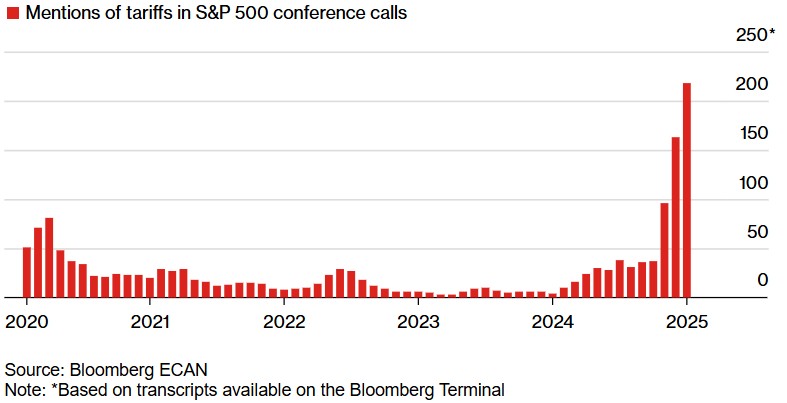
With so much noise perhaps it is worth taking a step back to remind ourselves Trump’s objectives. These tariffs are part of Trump’s “America First” agenda, aimed at revitalizing US industries and to stop the US getting “ripped off” by other countries due to trade imbalances. In other words, the US is going to turn old school protectionist. Which is why, after his election win in November, investors piled in to US stocks, Bitcoin and the US dollar, as the consensus was the US was the only place to be invested. This was the playbook from Trump’s first term.
But a month into Trump’s second term, the euphoria around many of these trades has faded, volatility has picked up, and the 2017 playbook is looking as valuable as the Trump memecoin.
There are a number of reasons for this.
Firstly, Trump is erratic. Who knows what he is going to announce next ? I am not even sure his own team know. And this uncertainty around the stop-start trade war has begun to hurt confidence in the US economy .
Also, the president’s tariffs have been less aggressive (so far) than many feared, and it often seems that the tariff threats are merely a tool to bring other countries to the negotiating table, and perhaps some of these countries will be less timid this time around. In 2018 when Trump first announced tariffs against China, they largely rolled over. But China has learnt the lessons from last time. When Trump announced a 10% duty on all Chinese imports, China’s response was swift but calculated. China are bring a scalpel to a sword fight. This targeted approach on a relatively small amount of American products, a fraction of what Trump targeted, demonstrates China’s ability to inflict further pain on US companies if needed. China has also diversified their exports away from the US since the first Trump tenure, and their recent restrictions placed on exports of some minerals used in clean energy and defence, shows they are ready to fight back. “We’re ready to fight till the end,” the Chinese Embassy in the U.S. said in a post
Lastly, the economic backdrop looks very different in 2025. Interest rates are higher. US equity valuations are more expensive. The US dollar is stronger. The workforce is older. And, the federal deficit is far larger than it was in 2018 when tariffs were first announced. Most importantly, Inflation is higher and rising. Given that tariffs are inherently inflationary, deportations will be inflationary, and tax cuts are inflationary, how much room does Trump have? And when push comes to shove will Trump chose an alternative path which is pro-growth but less inflationary?
Social Media Ga-Ga
With so much noise around, noise which is mainly being generated by the same individuals, how do we figure out what is going on and position our portfolios accordingly?
Well, for starters, successful investing requires a healthy level of paranoia. At any one stage we need to ask ourselves what we are we missing? What is different from last time?
What we are looking for is the actual ‘elephant in the room’. What is not priced in to current news. This is not about taking a contrarian view for the sake of it, we are looking for underpriced opportunities. Questioning the consensus to which most market participants are anchored can provide us with attractive entry points and create payoffs when the consensus shifts. In other words, if everyone is buying the same stuff then who is the marginal buyer to keep pushing the price higher.
These ideas don’t always work, but identifying these long term opportunities at attractive valuations skews the odds in our favour.
Since 2017 the US stock market has outperformed all other major markets every year aside from two years, so the narrative has been ‘US stocks are the only place to invest your capital’. This is the US exceptionalism that is commonly spoken about and US stocks have been trading at their most expensive levels since the dotcom bust in 2000. History is littered with examples of markets that seemed invincible—until they weren’t.
In addition, the world is clearly changing. The free trade, free markets, globalisation era is over, and nobody knows what’s going to replace it. Trump’s actions so far, with his tariffs and political posturing, have seen capital start to flow out of the US to Europe and Asia.
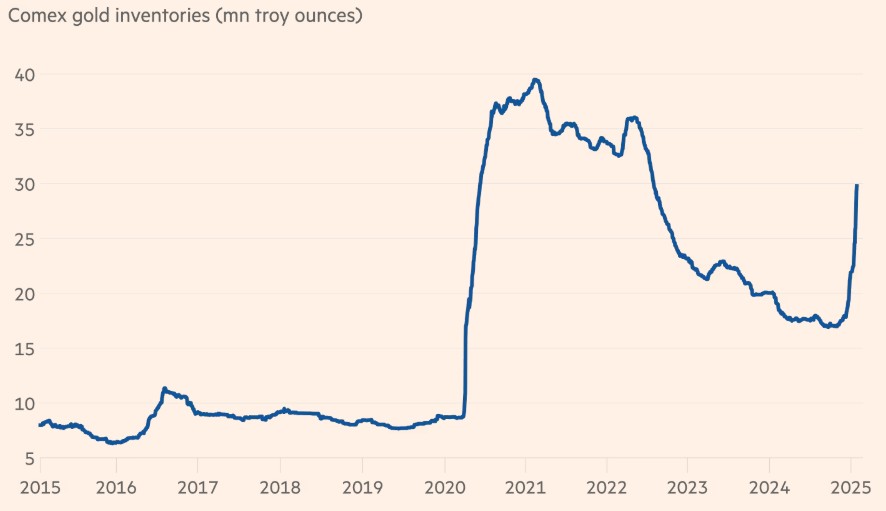
Regime shifts of this kind do not happen often. But they do happen. The speed and scale of this shift is so rapid that this needs to be acknowledged as a possibility. The role of the US dollar as the world’s reserve currency is not above reproach. Government spending in the US has been the dominant driver of economic growth since 2009, but the country has racked up $36 trillion of debt in the process. $10 trillion of this debt needs refinancing this year alone. We need to ask ourselves why so much physical gold is being moved from London vaults or why central banks are accumulating gold at a record pace. It is not because they are bullish on the US dollar or US treasuries.
Allgegenwärtig-elefant
This has been one of the hardest articles to write as everyday there seems to be another news story, but we must resist getting caught up in the noise and remain focussed on long term trends. It is difficult to know how the US tariff strategy will play out, but it is becoming increasingly obvious that the US government’s financial situation has become precarious. We are now entering a period of global rebalancing, US dominance is over, and we have positioned our portfolios to benefit from this dynamic.
The Germans seem to have a word for everything, and many of them don’t have a literal translation to English. Two of my favourites are Kummerspeck and Schnapsidee. Kummerspeck translates as ‘grief bacon’ and is the name for the extra weight someone puts on after a break up by eating comfort food. Schnapsidee translates as ‘alcoholic drink idea’ and refers to those ideas that seem great when you are drunk, but ridiculous the day after!
So, after conducting lengthy and robust language research (I googled it!) I am submitting a new phrase into the lexicon…..
Allgegenwärtig-elefant. The ubiquitous elephant.
Trademark pending.


