

When the Beatles first came to America in 1964, they told everyone they wanted to see Muddy Waters and Bo Diddley. One American reporter asked: ‘Muddy Waters … Where’s that?’.
American rhythm and blues artists (the original meaning of R&B!) such as Chuck Berry, Muddy Waters, Little Richard, and James Brown are household names these days, but in the 1950’s they were overlooked and underappreciated in their own country. Many black artists faced discrimination in the music industry, and the lack of radio airtime prevented them from topping the charts.
At the same time, across the pond in Britain, a generation of young musicians were importing and sharing blues records from these overlooked artists. Bands were being formed on an almost weekly basis, performing cover versions of blues songs, and writing their own songs, influenced by US blues artists. Britain’s adoption of the blues in the 1950s was instrumental to the development of rock ‘n’ roll, and bands such as The Rolling Stones, The Animals, The Kinks, and, of course, The Beatles took their music to America in the 1960’s and sent crowds wild with this ‘original’ fresh sounding style of music. UK artists began to dominate the American airwaves for the first time ever, and it became known as the British Invasion.
Don’t let me be misunderstood
British Invasion bands raised the profile of many overlooked US blues artists, who finally got played on US radio, and became noticed by the mainstream.
In previous articles we have espoused the benefits of holding gold within our portfolios, and after hitting new all time highs, gold has once again captured investor’s attention. Just as important, but hugely overlooked, is silver.
Silver, like gold, is a precious metal that offers investors protection during times of economic and political uncertainty as store of value. The prices of gold and silver bullion have generally risen and fallen in tandem over time, and when gold moves, silver usually follows. This relationship is expressed as the Gold-Silver ratio, which is simply how many ounces of silver it would take to buy one ounce of gold on any given day. You would currently need 86 ounces of silver to buy an ounce of gold, but the long term average since the 1970’s is around 65:1 which would imply that silver has lagged in this current gold bull market, and is ready to catch up.
Now before you all rush out to buy silver bars, let’s get the bad news out of the way first. Silver is a much smaller market than gold, and as such the prices are super volatile. Most commodities are fairly volatile, but silver prices are like gold prices on steroids. Also, the biggest buyer of gold this year has been central banks who hold physical gold in their reserves. Silver is far less valuable per ounce so it doesn’t make sense to store silver in the same way, as stated above you would need 86 times the amount of space. Lastly, much of silver’s value is also derived from its industrial demand. Approximately 60% of silver is used in industrial applications, like solar panels and EV cars, so in a economic slowdown silver demand could decrease.
It’s at this point in the story that you may have spotted the plot twist. Silver’s industrial applications actually underpin the investment case rather than detract from it. Ok, not quite an M. Night Shyamalan twist, but bear with me.
Got to Get You Into My Life
Silver demand continues to surge. Silver is second only to oil as one of the most widely used commodities, with more than 10,000 applications worldwide.
Solar panel manufacturing is increasing in volume every year and silver is a key component in photovoltaic cells. Silver is also used in Electric Vehicle (EV) batteries, but the real game changer could be the break though in solid state batteries. This technology could not only transform the EV market but requires a substantially greater amount of silver than a standard lithium battery. A standard EV requires between 20 to 50 grams of silver, but a vehicle that uses solid state batteries will require about 1kg of silver.
Other demand drivers for silver are semiconductors, sensors, jewelry and silverware. And with defensive spending increasing globally, silver is also used in a number of military applications including radar, night vision equipment and munitions.
In short, the global transition away from fossil fuels to an electrified economy is impossible without silver.
You Can’t Always Get What You Want
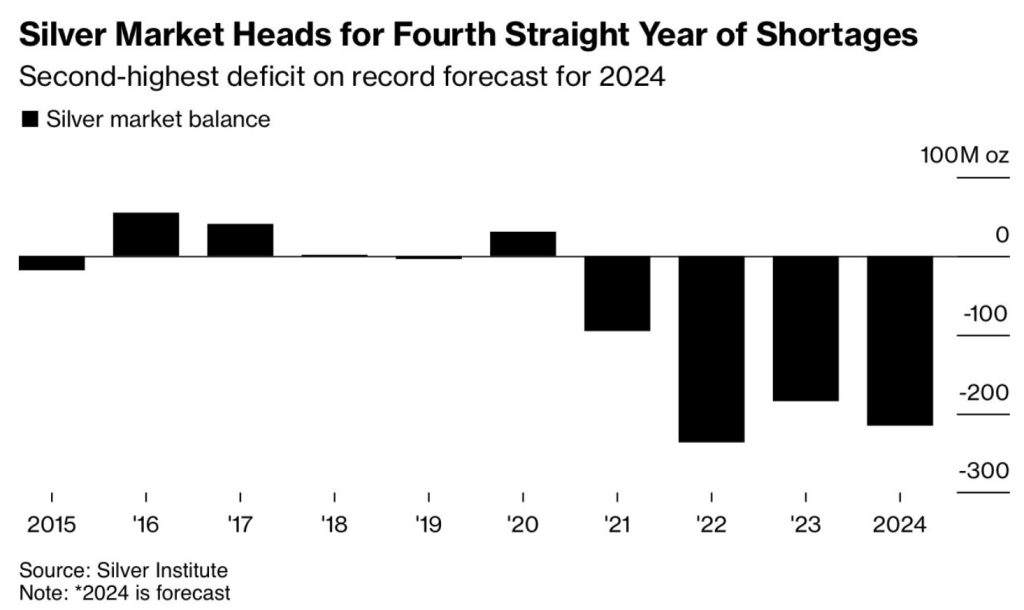
For the last two years the global demand for silver has been around 1.2 billion ounces, yet the supply has only been about 1 billion ounces, of which about 200m ounces had to come from recycling existing silver. This year will be the fourth consecutive year that the global silver market has recorded a physical deficit, and more importantly, this deficit will persist for the foreseeable future.
Even if mining companies allocate significant resources to finding new sources of silver and developing new mines it will take time for production to ramp up and ease the supply shortage. The industry also suffers from a lack of investment in primary silver mines. Over 70% of silver currently mined is as a byproduct of mining for gold, copper, and other metals. For the next few years at least, we will have to depend on drawdowns of above-ground stocks to meet the supply deficit.
Lastly, according to the US Debt Clock, there are currently 408 ounces of “paper” silver for every one ounce of actual physical silver. With such an extreme paper-to-physical ratio, even a modest shift in investor preference toward physical silver could force a dramatic repricing of the metal.
If you still believe in the basic economic principle of prices being established by supply and demand, silver looks well placed to move from the overlooked fringes to the investment mainstream.
The eagle flies on Friday
So, is silver a precious metal like gold, or is it an industrial metal like copper? Well, it’s both. We have written about the benefits of holding gold within portfolios HERE and HERE, and also written about how we are entering a new commodity supercycle HERE. Silver provides us with a ‘heads I win, tails I don’t lose’ trade. It can benefit from economic growth and growing industrial demand, while maintaining a degree of insulation against geopolitical risks and vast debt being accumulated in many countries across the globe.
There is an old blues standard called ‘Stormy Monday’ recorded by T-Bone Walker (great name) in 1947. The verse will resonate with investors in commodities and other overlooked assets.
“They called it stormy Monday, but Tuesday is as just as bad, Oh, Wednesday is worse, and Thursday also sad”
Some weeks can feel like this. We need to remain patient, be brave and have faith that our approach will ultimately pay off.
The verse continues “The eagle flies on Friday, and Saturday I’ll go out to play”. This lyric refers to getting paid on Friday. For silver investors, just like the US blues artists of the 1950’s who finally got played on the radio, that pay day is coming.
And in a final plot twist, the name of the American silver coin is?… The Silver Eagle.
Sources:
Bloomberg, UBS Bank, Sprott Money, Mining.com, The Silver Institute, Metals Focus, US Debt clock


