

What is the best trilogy? Lord of the Rings? The Godfather? The Cornetto Trilogy?
Personally, I think it is a toss-up between the original Star Wars and the Dark Knight Trilogy, but there may be some strange people out there who think it is The Hangover, or Naked Gun. Let me know, I am genuinely intrigued. Also, it’s nice to know people actually read these updates.
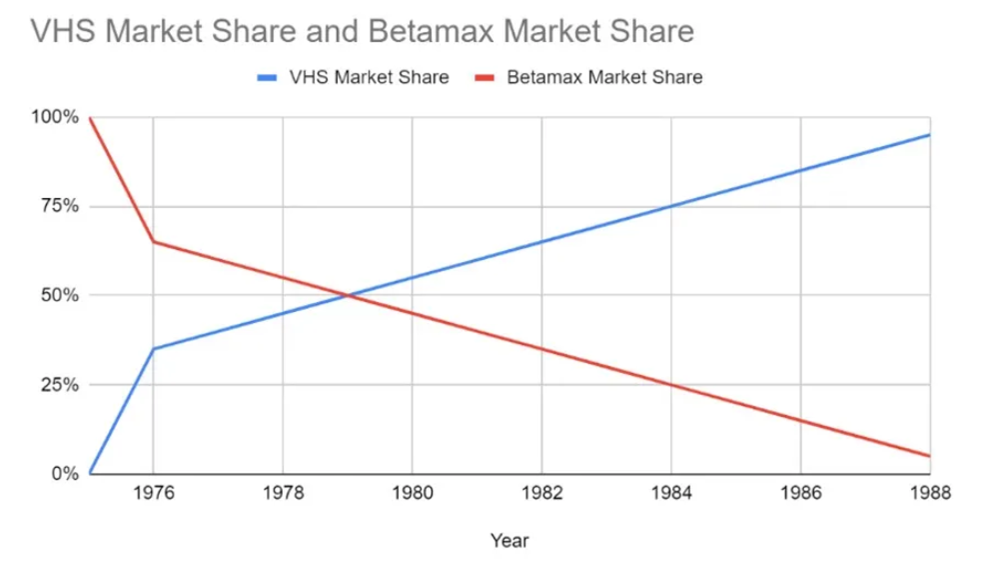
I first watched Star Wars on a VHS video, which we rented from the local newsagent. This was a thing in the 80’s, trust me. If you don’t know what a VHS video is then go and ask your parents, and they can explain. Fifty years ago Sony released the first ever Video Cassette Recorder (VCR) called the Betamax, and a few years later JVC released a competitor product called VHS, which created a format war., the VHS went on to dominate, and by the late 80’s Betamax was an obsolete format, Despite being the first mover and the higher quality product. JVC was able to produce their VHS machines cheaper, which grew their market share quickly. But more importantly, their cassettes could record up to 2 hours compared to 1 hour on a Betamax cassette, which meant that a greater number of films to rent were on VHS format. This was a classic case of having a superior product but not understanding your customer’s needs.
In our previous articles we talked about expensive valuations (Val D’espair) and how interconnected many companies in the AI space have become (Connection Racket), so the final saga of The Bubble Trilogy will pose the ultimate question – Who will be the big winners in the AI revolution?
Up until now I think the most obvious answer must be Nvidia.
Over the past decade, Nvidia has evolved from a niche video graphics chip pioneer into a tech behemoth in AI chips, and is now one of the world’s most valuable companies, with its technology used by millions of developers and tens of thousands of firms worldwide.
Nvidia’s chips have become the gold standard in the AI market because the company has been making GPUs for far longer than anyone else. Graphics Processing Units, or GPUs were created to speed the rendering of graphics, mainly in video games, but turned out to be well-suited to training AI models because they can handle large amounts of data and computations.
But now cracks have started to appear. Even though their recent results were above expectation (which they always are, funnily enough) and the shares initially spiked, they very quickly fell again as investors started looking though in more details and started to question whether such a high level of demand for GPUs, and the truckload of cash required to buy them, can continue to be sustained in the long term.
There are four key concerns with Nvidia
- Along with Open AI, Nvidia are at the heart of the circular AI merry go round, providing their customers funding ‘guarantees’ so they can raise money from banks to then, wait for it, buy Nvidia chips.
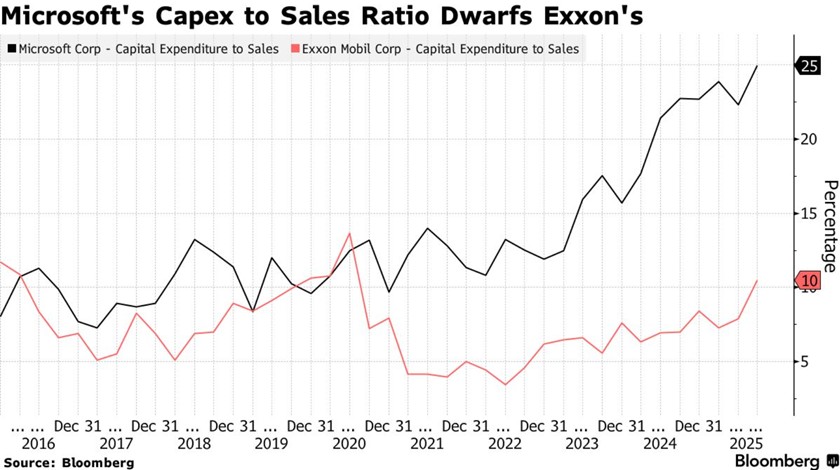
- Most of their business comes from just a handful of firms, in fact, 40% of Nvidia’s revenues come from just two customers (not disclosed but will almost certainly be two of the Mag 7). Historically the tech industry has been a capital light business model, but many of these tech giants are having to embrace a capex-intensive model to ‘win’ in the AI arms race. For example, Microsoft’s capex is now 25% of its revenue, more than three times what it was 10 years ago. This hasn’t been an issue so far, but eventually shareholders will ask what they are getting for all this spending, and there will be a knock-on effect for Nvidia’s profits.
- Google. For some time, Google (or Alphabet in new money) has been considered an AI ‘loser’, but the search engine giant has awakened, and the recent rollout of Gemini 3.0 into its current 4 billion user ecosystem (YouTube, Gmail, Maps, search engine etc.) mainly using their own TPU chips rather than Nvidia’s GPU chips. Google are threat to both Nvidia and OpenAI.
- There are still a lot of unknowns. How much productivity will AI actually create? How long chips will last? What energy needs will be required? What will be the knock-on effect on the electricity grid (which powers them) and the water (which cools them down).
Who will be the big winners in the AI revolution? We honestly have no idea, but neither does anyone else.
Sometimes stocks get priced like their ability to generate profits is a foregone conclusion. With any nascent technology it is not always the most obvious company that wins the race. Google was not the first search engine but became the biggest. As we saw with the video recorder format war in the 80’s, Betamax went the same way as Napster, Friends Reunited, Ask Jeeves, and my entire mini-disc collection.
This is not to say Nvidia is doomed or that is not a great company, there is a reason it got to a $4.5 trillion valuation; but investors need to be aware of what they hold. Nvidia makes up 7% of the S&P 500 and continued share price weakness could spook the market, especially the tech sector. By contrast, the entire gold mining sector (albeit just one company) only represents 0.08% of the US Stock market, despite rising 150% year to date.
This is why we prefer to find opportunities that are under owned and undervalued.


